
2026 3rd International Conference on Economic Data Analytics and Artificial Intelligence(EDAI 2026) &The 2nd International Conference on Low Carbon Economy and Sustainable Development(LESD 2026) Successfully Concluded
From October 23 to 25, the 3rd International Conference on Economic Data Analysis and Artificial Intelligence (EDAI 2026), jointly held with the 2nd International Conference on Low-Carbon Economy and Sustainable Development (LESD 2026), was convened at our university, with the main agenda scheduled on October 24. Experts and scholars from domestic and international universities and research institutes attended both online and on-site. They engaged in in-depth discussions on frontier topics including economic data analysis, artificial intelligence applications, low-carbon technological innovation, green transition, and sustainable development, building an interdisciplinary and open international academic exchange platform.
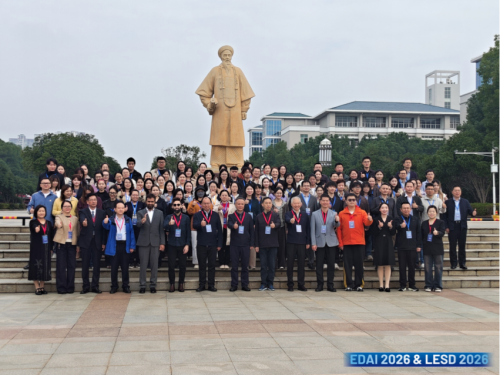
Group photo of all conference participants
At the opening ceremony, Prof. Huang Zebo, President of our university, delivered a welcome address. He extended warm welcome to the distinguished guests and scholars present from home and abroad, and expressed high expectations for the academic exchange value of this interdisciplinary conference.
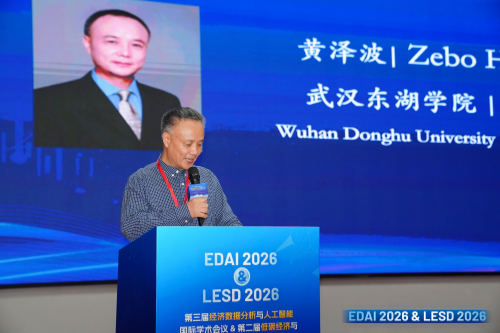
President Huang Zebo delivering the address
The opening ceremony was chaired by Prof. Sun Ximing, Dean of the School of Economics at our university.
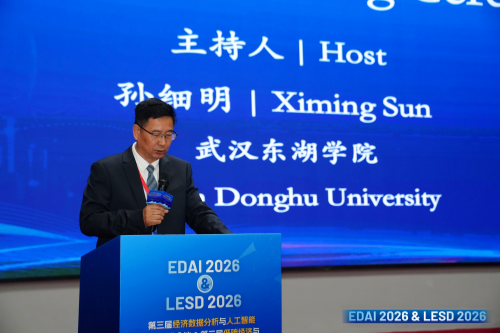
Dean Sun Ximing chairing the opening ceremony
The conference featured 5 keynote speeches by distinguished experts, 18 oral presentations by young scholars, and a poster session. Experts and young researchers exchanged ideas on hot topics such as opening-up, human-machine ethics, AI technology iteration, industrial chain security, and large model deployment. Diverse disciplinary perspectives inspired one another, creating favorable opportunities for cross-institutional and cross-domain research collaboration.
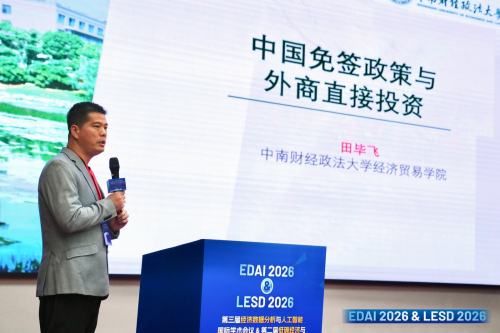
Prof. Tian Bifei from Zhongnan University of Economics and Law delivering the keynote
Prof. Tian Bifei from Zhongnan University of Economics and Law delivered a keynote speech titled “China’s Visa-Free Policy and Foreign Direct Investment.” The report systematically reviewed policy developments since 2024, including the expansion of visa-free scope, optimization of transit visa-free policies, and recovery of international flights. It analyzed the inherent logic between adjustments in opening-up policies and foreign direct investment, providing empirical research reference for evaluating the economic effects of opening-up policies.
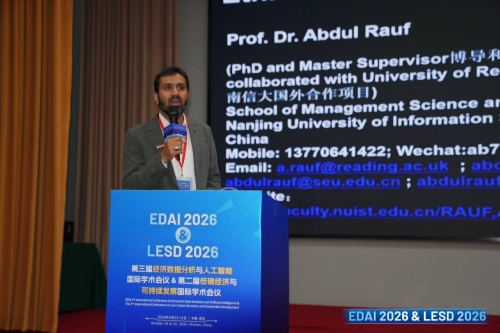
Prof. Abdul Rauf from Nanjing University of Information Science and Technology delivering the keynote
Prof. Abdul Rauf from Nanjing University of Information Science and Technology delivered a keynote speech titled “Automation Is Easy, Accountability Is Hard: Human-Machine Collaboration and Ethical Development Prospects for Chinese SMEs.” The report focused on practical challenges after technology implementation, exploring the issue of responsibility attribution in scenarios where humans and machines jointly participate in decision-making.
Prof. Yu Qian from Wuhan University of Technology delivering the keynote
Prof. Yu Qian from Wuhan University of Technology delivered a keynote speech titled “Trends, Policies, and Scenario Applications in the AI+ Era.” The report discussed three dimensions: technology evolution trends, policy development environment, and real-world scenario applications, with a focus on embodied intelligence and related technological directions.
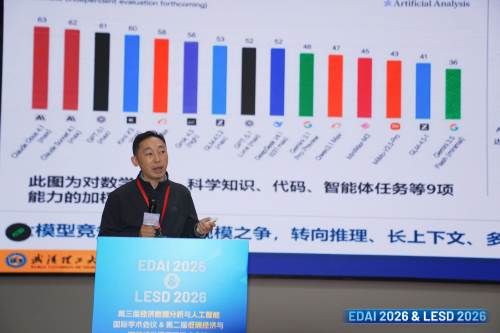
Prof. Shuai Chuanmin from Wuhan Donghu University delivering the keynote
Prof. Shuai Chuanmin from our university delivered a keynote speech titled “Research on the Impact of Digitalization on Supply Chain Security in Photovoltaic Enterprises.” Taking photovoltaic industry enterprises as research samples, the report explored the internal mechanism by which digital transformation empowers supply chain security, providing practical insights for the digital upgrading of the photovoltaic industry and safeguarding industrial chain security.
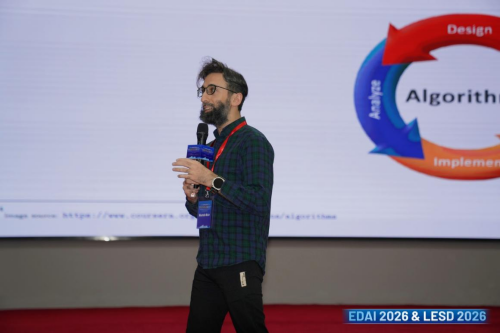
Assoc. Prof. Mustafa Misir from Duke Kunshan University delivering the keynote
Assoc. Prof. Mustafa Misir from Duke Kunshan University delivered a keynote speech titled “Multi-Criteria Meta-Routing Algorithms for Economic Decision-Making: Enabling Efficient and Reliable Large Model Deployment.” The report focused on multi-criteria decision-making and meta-routing algorithms, discussing how to select and combine various algorithms to ensure efficient and stable deployment of large models across different business tasks.
In the afternoon oral presentation session for young scholars, 18 young researchers delivered presentations in succession. Their research covered diverse directions including green governance, corporate investment behavior, intelligent detection algorithms, macroeconomic forecasting, Chinese public opinion sentiment analysis, and holiday economy intercity travel, balancing empirical analysis with technological applications and fully demonstrating the innovative thinking of young researchers.
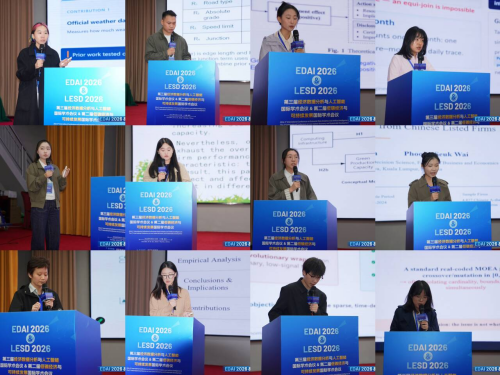
Young scholar oral presentation session
To encourage young researchers to deepen their academic work and produce high-quality outcomes, the conference awarded 3 prizes for Outstanding Oral Presentations, 5 prizes for Outstanding Papers, and 2 prizes for Outstanding Posters.
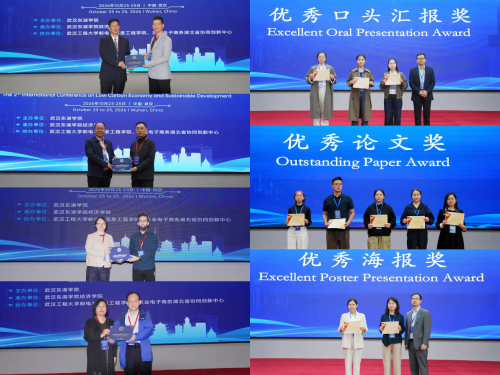
Award ceremony
The successful conference effectively promoted academic dialogue at the intersection of economics, artificial intelligence, and low-carbon sustainable development, further enhancing the international academic influence of Wuhan Donghu University. Going forward, the conference will continue to gather research strengths from home and abroad, and drive academic exchange and collaborative innovation in related fields to deeper levels.